An overdue invoice email has one purpose: to get a date. Not an apology, not an explanation, not a promise — a date when the money moves.
Almost every email that fails does so in the same place: it asks for payment without asking for a date.
The structure that works
Four lines, in this order:
- The reference. Invoice number, amount, due date. In the first two lines, because finance teams triage by reference
- The fact of lateness. "Now 12 days overdue" — a number, not a feeling
- The ask. A specific date or confirmation, not "please expedite"
- The exit. What happens if the payment is already scheduled — so a good client is not forced to argue
Everything else is decoration.
Subject lines that get opened
The subject decides whether the email is read today or on Friday:
- ✅
Invoice 2026-114 — 12 days overdue - ✅
Invoice 2026-114 — payment date? - ✅
Overdue: invoice 2026-114 (£4,000) - ❌
Following up - ❌
Quick question - ❌
Sorry to chase again!
The pattern: reference plus status. No adjectives.
A full example
Subject: Invoice 2026-114 — 12 days overdue
Hi Anna,
Invoice 2026-114 for £4,000 was due on 11 November and is now 12 days overdue.
Could you confirm a payment date? If it is already scheduled, tell me the date and I will stop chasing. If something is missing on our side — a PO number, a signed timesheet, a corrected address — send it and I will fix it today.
Our terms include interest on late payment, but I would rather sort this out between us first.
Marc
The one sentence most people leave out
If it is already scheduled, tell me the date and I will stop chasing.
This does two things. It gives the client a way to end the pressure without paying today — which is usually the actual blocker. And it converts a defensive reply into useful information.
A client who is genuinely going to pay next week has no reason to avoid that sentence. A client who has no intention of paying cannot use it.
The three mistakes that keep an invoice unpaid
1. Softening the ask into nothing. "Just floating this to the top of your inbox" contains no request. The reader files it under "no action needed".
2. Writing to the wrong person. The person who ordered the work usually cannot release the payment. If two reminders go unanswered, move up one level and copy the original contact.
3. Attaching the invoice again without saying why. A re-attached invoice reads as "you lost it". Say explicitly: "attaching again in case it did not reach finance".
Timing: when to send it
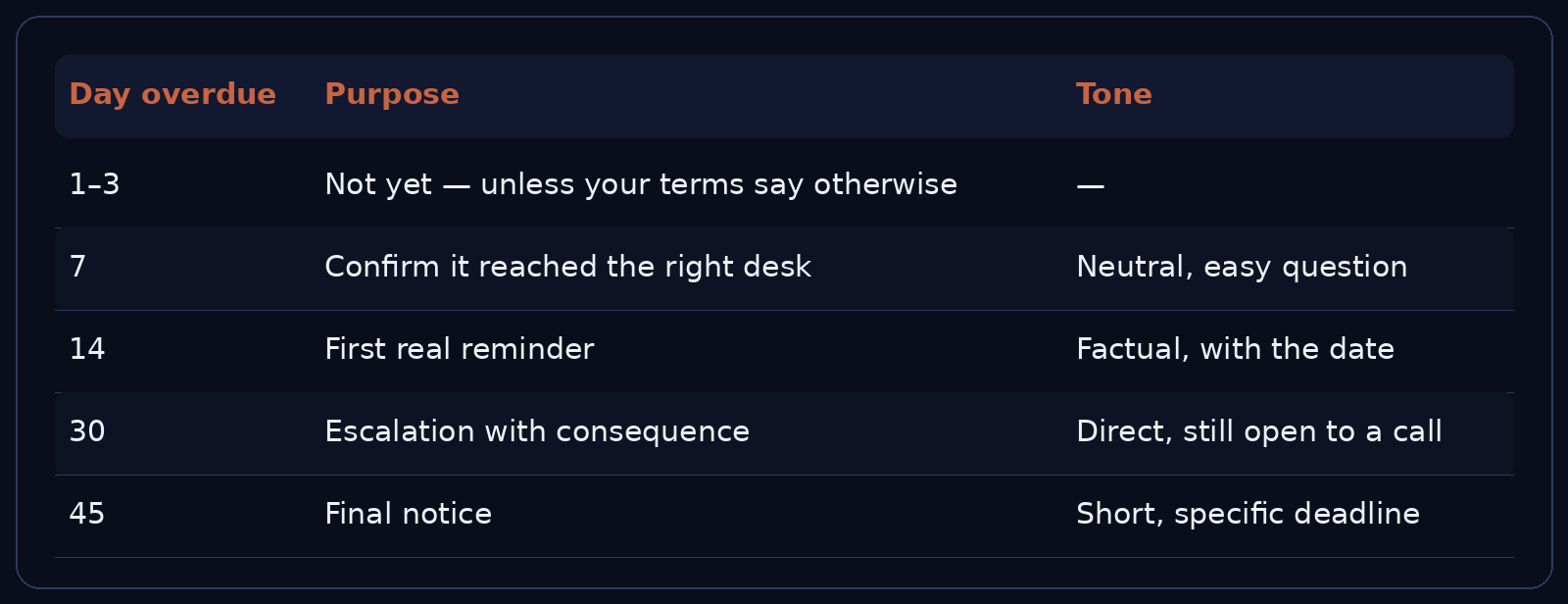
Sending earlier than day 7 reads as distrust. Sending later than day 14 costs you a payment cycle.
If the email is ignored twice
Stop writing emails to the same address. Two options, in order:
- Call, then email a summary of the call. "As agreed on the phone, payment on 5 December." The email is what makes the call count
- Escalate in writing to their manager, copying the original contact, with the full history in one place
Silence is information: it usually means the invoice is stuck in an approval chain, not that the client is refusing.
How to stop writing these by hand
The schedule is mechanical — day 7, 14, 30, 45 — and each email is a variation of the same four lines. That is exactly the kind of thing that should be sent automatically, from your own address, in the same thread as the invoice.
In DueBuddy the invoice is read into data, the schedule is set once, and the reminders go out on their own. See the reminder routine or take the templates.