A late fee has one job: to make paying on time cheaper than paying late. Most businesses add one and never collect it, because the clause is written in a way that cannot be enforced, or because nobody applies it.
Here is how to make it real.
The clause has to exist before the invoice
You cannot add a late fee after the payment is late. It has to be in the contract, the engagement letter, or the terms you sent with the original quote — and the invoice has to reference it.
The minimum working version, in one sentence:
Invoices unpaid after the due date incur interest at 1.5% per month, calculated daily from the due date until payment.
That sentence does three things: states the rate, states the base (monthly), states when it starts.
How much to charge
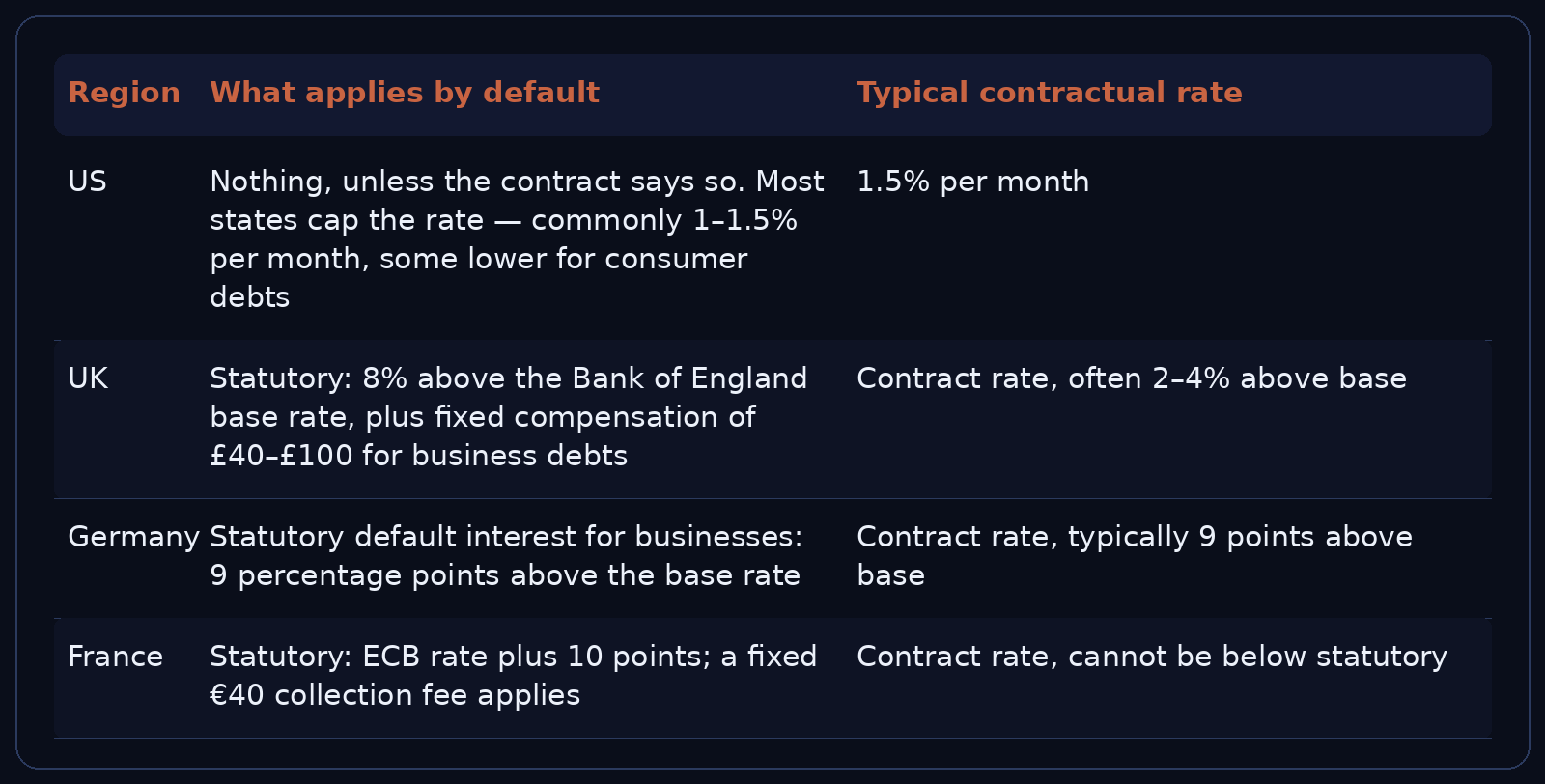
If you invoice several countries, put the rate in the contract as a number, and add "or the maximum permitted by law, whichever is lower". That keeps the clause alive in every jurisdiction you sell into.
What a late fee does not do
It does not get you paid. At 1.5% per month, a £4,000 invoice that is 30 days late earns £60. Nobody pays £4,000 to avoid £60, and a client who is short of cash will treat the fee as a cost of doing business.
What it does:
- Changes the conversation. "The balance including interest is £4,060" is a different email from "please pay £4,000"
- Documents the timeline. A stated fee makes the overdue status objective, not a matter of opinion
- Supports a claim later. In court or in collections, an unpaid fee is evidence of a documented debt
When the fee is not worth applying
Three situations where charging interest costs more than it earns:
- A good client, 3 days late, once. Apply nothing, mention nothing
- A client who is disputing the work. Fix the dispute first — interest on a disputed invoice is noise
- An amount smaller than your own admin time. £12 of interest is not worth a phone call
Decide your threshold in advance, in writing. "We waive interest on the first late payment per client, once per year" is a policy. "We will see how it goes" is not.
The mechanics: how to actually charge it
- Recalculate on the day you write. Interest accrues daily; a number from last week is already wrong
- Issue a separate debit note — not a new invoice for the same work. Reference the original invoice number
- State the formula, not just the total: principal × rate × days / 365. Clients pay what they can verify
- Apply it, or explicitly waive it. Never "forget" it — that teaches the client your terms are decorative
Example:
Debit note DN-2026-041, relating to invoice 2026-114. Principal £4,000.00, overdue 34 days at 1.5% per month (18% per annum): interest £67.07. Total due £4,067.07.
Why most late fees are never collected
Because they are applied inconsistently. A client who is charged interest once, waived once, and ignored once learns that the clause is a mood, not a term.
The rule is simple: apply it the first time the threshold is crossed, and waive it openly when you choose to. One consistent behaviour beats any rate.
Practical guide, not legal advice. Statutory interest rates change — check the current reference rate in your jurisdiction before quoting a figure in a contract or an email.