Payment terms are the part of the invoice nobody reads until the money is late. Then they matter more than the amount, because they decide who is right.
Here is what belongs on the invoice, which term to pick, and the wording that actually holds up.
The four fields that make terms enforceable
An invoice without these is a request, not a document:
- Due date — as a date, not a period. "Due 15 November" beats "Net 30". If you write a period, the clock starts from a date the client can argue about: invoice date, receipt date, or the day their finance team opened the email.
- The trigger event. Say what starts the clock: date of invoice, date of delivery, or date the work was accepted. Pick one and use it everywhere — in the contract, the invoice, and your reminder emails.
- Late payment consequence. Interest, a fixed fee, or suspension of work. Without a stated consequence, your only remedy is a court, and that costs more than the invoice.
- Payment route. Bank details, reference format, and — for cross-border work — who pays the transfer fee. "All bank charges are borne by the payer" saves 15–30 currency units per invoice.
Which term to choose
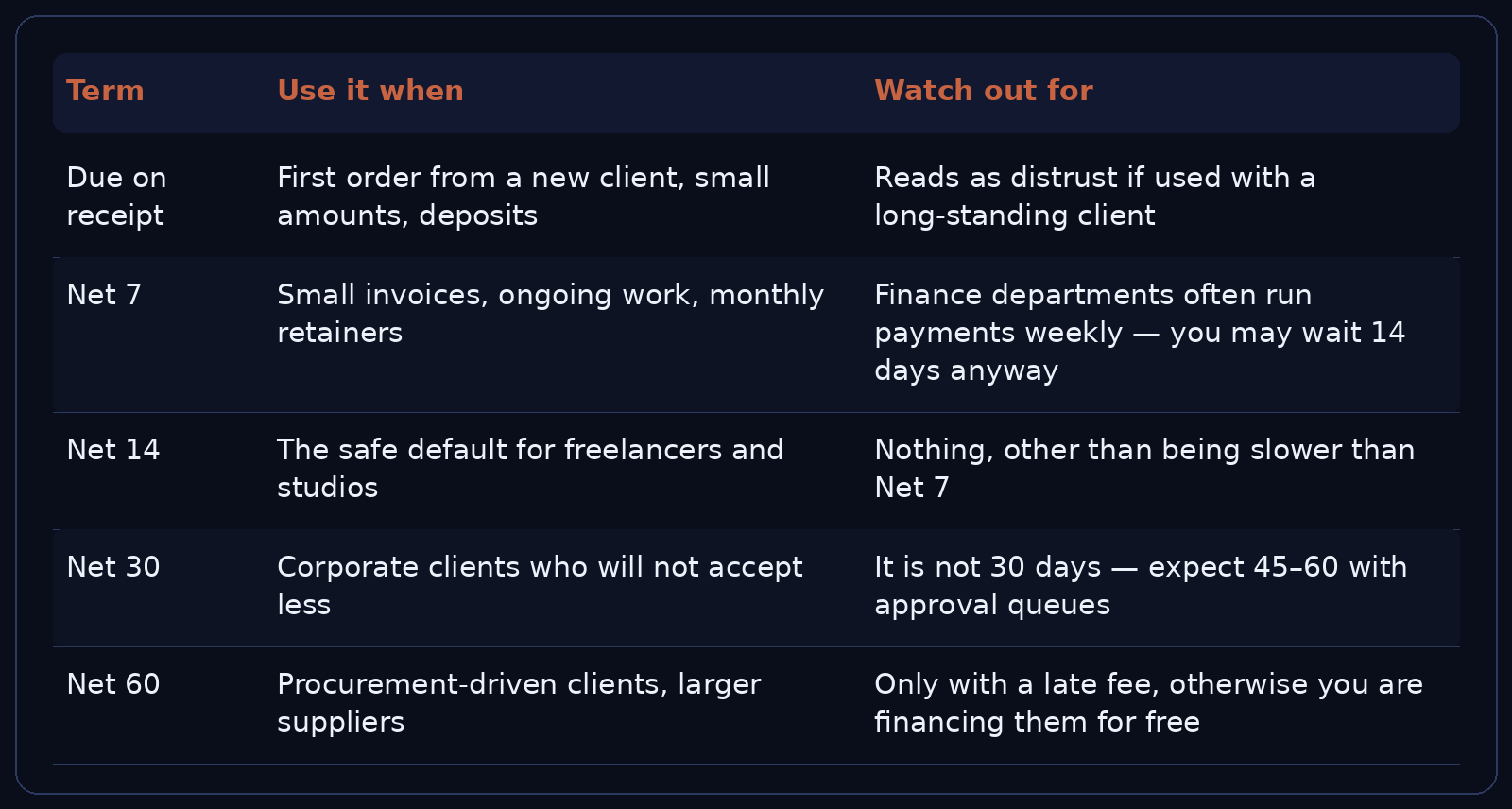
Practical rule: the term should be shorter than the length of your project cash cycle. If you pay subcontractors on delivery, Net 30 means you fund the gap personally.
Wording that holds up
Add these lines to the invoice footer or the contract — short, plain, and specific:
Payment is due by 15 November 2026. Late payments incur interest at 8% above the Bank of England base rate, accruing daily from the due date.
We may suspend work on any account more than 14 days overdue, after written notice.
Please quote invoice number 2026-114 as the payment reference.
Three sentences. Each one closes a specific argument: when the money is due, what happens if it is not, and how the payment can be matched to the invoice without an email chain.
Terms across borders
- US: payment terms are contractual, late fees must be stated in the agreement (typically 1–1.5% per month). "Net 30" is standard; many states cap default interest.
- UK: statutory interest of 8% plus the base rate applies to business-to-business debts, plus a fixed compensation of £40–£100. You do not need it in the contract.
- Germany: "Zahlbar innerhalb 30 Tagen netto" is the norm; a 2–3% discount for early payment is common and legal.
- France: the legal maximum for B2B is 60 days from invoice date, or 45 days from end of month.
If you invoice across several countries, put the governing law and the payment term in the same sentence. Splitting them is how disputes start.
The terms that quietly cost you money
- "Payment within 30 days of receipt" — receipt by whom? The mailroom? The approver? Every ambiguity adds a week
- "As per contract" — the invoice must stand alone. If the invoice is forwarded to a finance team that has never seen the contract, the terms disappear
- No reference number — unmatched payments sit in a suspense account for weeks
- Percentage late fee with no base — "1.5% late fee" per what: month, year, or invoice? State it
What to do today
- Open your invoice template and check the four fields above
- Pick one trigger event and use the same wording on every invoice
- Add the interest clause — one line, and it changes the tone of every reminder that follows
- Set the term one step shorter than feels comfortable. You can always extend for a good client; you cannot shorten retroactively
This is a practical guide, not legal advice. Statutory rates and rules depend on your jurisdiction and change: check the current figure before you quote it in an email.