There is a point where chasing an invoice stops being cheap. You keep sending emails because each one takes four minutes, and four minutes feels cheaper than handing 15–25% of the invoice to a collection agency.
That arithmetic is wrong more often than people think — but only after a certain point. Before it, chasing is genuinely the better option. The problem is nobody defines where the line is, so people either chase for nine months or escalate on day ten and lose a client.
What chasing actually costs
An overdue invoice in a small business typically takes four to seven contacts before payment: 30–50 minutes of attention, spread over weeks. Add the mental load — the invoice you see every time you open your books — and the real cost is closer to two hours.
That is worth it for £4,000. It is not worth it for £300.
The four signals to stop chasing
1. The contact has gone quiet for 21+ days. Silence after two reminders is not busyness. It usually means the invoice is stuck, disputed, or the company has a cash problem. Emails will not solve any of the three.
2. The story keeps changing. "Next week" became "after the 15th" became "once the client pays us". Two broken promises with no date mean the payment is not in anyone's plan.
3. The amount is above your threshold. Set it in advance: many small firms use one month of revenue, or a fixed figure like £1,000. Below it, writing off or waiting is cheaper than a fight.
4. The client is a company you can check. Late filings, changed directors, a strike-off notice — one lookup on the company register changes the decision from "chase" to "act now, before other creditors".
What stays the same in both cases
Whether you chase or hand over, the same three documents decide the outcome:
- The contract or engagement letter, with payment terms and any late-fee clause
- Proof of delivery — the signed timesheet, the accepted deliverable, the email saying "looks good"
- The invoice itself, with its issue date and the date it was sent
If you cannot produce those in ten minutes, no collection agency can help you, and neither can a court.
The handover: what to say
The email that ends your involvement is the one that most people either never send or send too late. It should be short, factual, and free of threat theatre:
Hi Anna,
Invoice 2026-114 (£4,000) is now 74 days overdue. I have written three times and have not received a payment date.
I am passing the account to [agency] for collection on 15 December. Payment before that date closes the matter with no extra cost to you.
If there is a genuine problem — a dispute, a missing document, a cash issue — reply today and I will hold the handover.
Marc
This does three things. It states a date. It leaves one last door open. And it creates the paper trail a collector will ask for anyway.
What collection actually costs
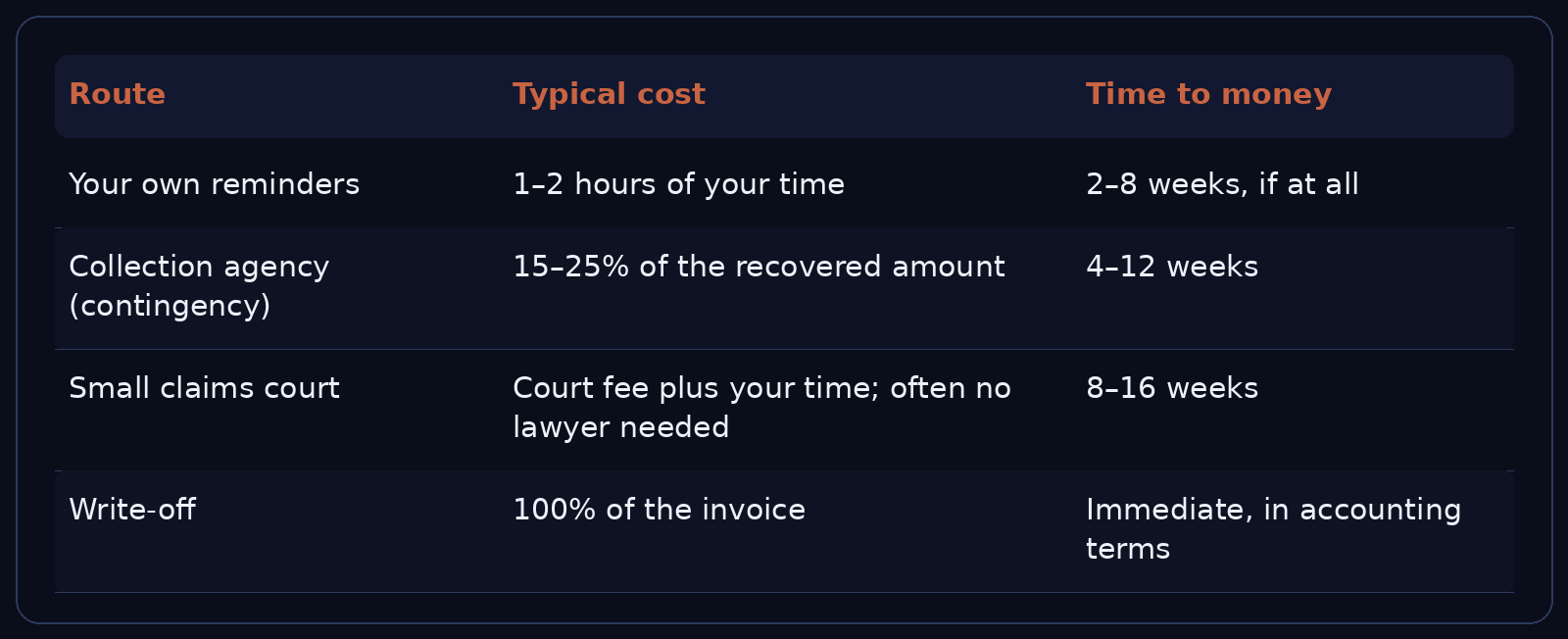
For a £4,000 invoice, a 20% contingency fee is £800. Two hours of your time is not £800. That is why the switch exists — and why most freelancers make it six months too late.
The practical rule
Chase while the cost of chasing is below the fee of collection. For a £4,000 invoice at 20%, that is £800 — roughly 40 hours of your time. You will never spend 40 hours on reminders, which means for most invoices above £1,000, escalation is a timing question, not a cost question.
The real constraint is different: the older the debt, the lower the recovery rate. Most recovery rates collapse after 90 days. That is the number to plan around, not the percentage.
How to make chasing cheap
If reminders cost two hours per invoice, chasing wins. If they cost five minutes, it isn't even a decision.
That is the only reason we built automation for this: the invoice goes in, the schedule runs (day 3, 14, 30, 45), the emails leave from your own address. You keep the relationship and stop paying for it in attention. How the reminder routine works.